Launched in 2018 and convened by UN Climate Change, the Fashion Industry Charter provides a framework for multi-stakeholder dialogue and engagement on climate action across brands and suppliers involved in the fashion sector. The overarching mission of the Charter is to drive fashion to net-zero emissions no later than 2050, in line with a 1.5°C pathway. This mission is underpinned by various commitments and values related to ambitious climate action, strong collaboration, a dedication to the Sustainable Development Goals, transparency and accountability, and respect for human rights.
What is the Fashion Industry Charter for Climate Action?
What is the Fashion Industry Charter for Climate Action?
The Fashion Industry Charter for Climate Action is the result of the work undertaken by fashion stakeholders in 2018 to identify ways in which the broader textile, clothing and fashion industry could move towards a holistic commitment to climate action. The work was kicked-off when UN Climate Change hosted the ‘'Dialogue on Enhancing Climate Action in the Fashion Sector'’, which brought together industry representatives to discuss the impacts of climate change and the Paris Agreement on the sector. These actors acknowledged that voluntary climate action was happening but on a limited scale, and that the diverse and dispersed nature of the business meant that effective action would require multi-stakeholder dialogue and engagement across policymakers, brands and suppliers. They also identified the need for cooperative action to support producers in aligning with net zero emissions, given the relevance of the supply chain in fashion's overall climate footprint.
Anchoring the initiative within the UN Climate Change was deemed crucial to providing a neutral, global forum for the necessary discussions on climate impacts and action among the diverse stakeholders from various phases of the sector's operations, which had so far been lacking. It was suggested that the UN Climate Change also use its convening power to support the fashion sector in planning and implementing climate action aimed at aligning the sector with the goals of the Paris Agreement, in addition to facilitating engagement between the industry, policymakers and adjacent sectors, such as the finance community. Reconvening in September to finalize recommendations that had been put together through a multi-stakeholder iterative process throughout the year, the group created the Fashion Industry Charter for Climate Action.
The Charter recognizes the need to reach climate neutrality by 2050. As a major global player, the fashion industry is poised to take an active part in contributing to this goal, by embracing deeper, more systemic change and scaling up low carbon solutions to reduce emissions from its operations, particularly in the manufacturing of products and materials. The Charter also notes that there are opportunities to reduce emissions throughout the global value chain, regardless of size and geography, and that these opportunities are consistent with, among other things, expanding economic opportunity, using resources more efficiently, driving economic competitiveness and innovation, and strengthening resilience.
Charter mission and commitments
Fashion Industry Charter for Climate Action mission is to drive the Fashion Industry to net-zero Greenhouse Gas Emissions no later than 2050 in line with keeping global warming below 1.5°C.
Charter mission and commitments
The Charter's overall goal and mission is to drive the fashion industry to net zero greenhouse gas emissions no later than 2050 in line with keeping global warming below 1.5 °C. Charter signatories commit to a number of actions on climate change, namely to:
- Support the goals of the Paris Agreement in limiting global temperature rise to well below 2 °C above pre-industrial levels;
- Commit to 30 per cent aggregate greenhouse gas emission reductions in scope 1, 2 and 3 of the Greenhouse Gas Protocol Corporate Standard15 by 2030 against a baseline of no earlier than 2015;
- Commit to analyzing and setting a decarbonization pathway for the fashion industry drawing on methodologies from the Science-Based Targets Initiative (SBTi);
- Quantify, track and publicly report its greenhouse gas emissions, consistent with standards and best practices of measurement and transparency;
- Partner with experts, businesses, investors, environmental advocates and other stakeholders to develop and implement a decarbonization strategy for the fashion industry, including by developing a work program and tools necessary to achieve the greenhouse gas emission reduction targets;
- Commit to prioritizing materials with low-climate impact without affecting negatively other sustainability aspects;
- Commit to continuously pursue energy efficiency measures and renewable energy in the value chain;
- As soon as possible and latest by 2025, commit to not installing new coal-fired boilers or other sources of coal-fired heat and power generation, on sites within Tier one and Tier two;16
- Support global transition to low carbon transport by giving preference to low carbon logistics;
- Support the movement towards circular business models and acknowledge the positive impact this will have towards reducing greenhouse gas emissions within the fashion sector;
- Establish a closer dialogue with consumers to increase awareness about the greenhouse gas emissions caused in the use and end-of-life phases of products, building towards changed consumer behaviors that reduce environmental impacts and extend the useful life of products;
- Partner with the finance community and policymakers to catalyze scalable solutions for a low carbon economy throughout the sector;
- Together with other stakeholders, develop a strategy including targets and plans to advocate for the development of policies and laws to empower climate action in the fashion industry, especially in supply chains;
- Establish a dialogue with governments in key countries to enable renewable energy, energy efficiency and the necessary infrastructure for a systemic change beyond the fashion industry;
- Communicate a shared vision and understanding through the development of a common strategy and messaging, including by championing climate action within the fashion industry through an enhanced and trust-building dialogue with relevant stakeholders;
- Support the UN Climate Change secretariat in its efforts to manage the tracking and recognition of progress of the commitments outlined in the Fashion Industry Charter for Climate Action.
Charter members are guided by the following core values:
- Ambitious climate action, where signatories support increases in ambition over time in line with the goals of the Paris Agreement and advance innovative solutions that address climate challenges;
- Collaboration, under the understanding that cooperation and communication are to be built in a culture of inclusion, empathy, mutual respect and meaningful collaboration;
- Dedication to the Sustainable Development Goals, acknowledging that all participating companies have opportunities to take actions that will result in a measurable reduction in greenhouse gas emissions, which in turn contributes to the broader Sustainable Development Goals;
- Transparency and accountability, where members operate with integrity, ownership and transparency, and maintain quality and relevance in their work, deliberations and thought leadership;
- Respect for human rights, under which participants in the Charter are expected to acknowledge the principles of the Universal Declaration of Human Rights and applicable United Nations charters and conventions.
Charter governance
A Steering Committee forms the Charter’s key governance body, with Working Groups convening regularly on specific topics to initiate, develop and deliver roadmaps to help them achieve the goals of the Charter.
Charter governance
The Fashion Industry Charter for Climate Action is an industry-led effort and, as such, has two categories of signatories:
- Brands, retailers and suppliers, which commit to implementing the principles (commitments) of the Charter and to working collaboratively with their peers and relevant stakeholders to develop, implement and enhance the climate action agenda in fashion. They are ultimately accountable for quantifying, tracking and publicly reporting greenhouse gas emissions, consistent with standards and best practices in terms of measurement and transparency.
- Supporting organizations, including non-governmental organizations, academia, industry associations, financial institutions, policy bodies and relevant initiatives, which commit to supporting the delivery of the principles in the Charter and are invited upon meeting specific criteria.
The UN Climate Change provides support, facilitating work under the Charter through an independent and inclusive platform, together with a framework within which the fashion sector can collaborate on climate action. Work under the Charter is delivered by the signatories and supporting organizations through working groups with the guidance of the Steering Committee.
The Steering Committee is the Charter's key governance body. It is composed of the working group Co-Chairs and reports to all signatories (for example, to highlight progress and offer recommendations). The Committee is led by two Chairs, selected by consensus by its members. They serve a two-year term (with the possibility of being renominated for one additional term) and their primary responsibility is to jointly guide the work and meetings in an inclusive and transparent way, and to serve as spokespersons and champions of the Charter.
The working groups are put together by signatories to initiate, develop and deliver road maps to help them to achieve the goals of the Charter, and each group may focus on one or more commitments. Charter signatories and supporting organizations are welcome to participate in as many groups as they wish, provided they commit to engage actively and ensure that relevant expertise is offered. Each group is led by two Co-Chairs, nominated by signatories and supporting organizations and chosen by their respective groups for a two-year term, which may be renewed once. They are responsible for proposing and facilitating workplans (which are created in a consultative process), leading the work and the meetings, engaging the group in its activities and deliverables, and serving as focal points.
There are currently 125 companies and 41 supporting organisations committed to the Fashion Industry Charter for Climate Action, up from 31 companies and 12 supporting organisations when the Charter was first launched, and work is being carried out under seven working groups: (1) Decarbonization Pathway and GHG Emission Reductions; (2) Raw Materials; (3) Low Carbon Manufacturing/Energy; (4) Policy Engagement; (5) Financial Tools; (6) Promoting Broader Climate Action; and (7) Brand/Retailer Owned or Operated Emissions. In 2019–2020, the Working Group on Logistics was convened to explore low-carbon logistics opportunities.
Steering Committee 2021 - 2022
Stefan Seidel
Head of Corporate Sustainability, PUMA SE
Co-Chair of Decarbonisation Pathway Working Group
Tracy Nilsson
Senior Director Social & Environmental Affairs, adidas
Co-Chair of Manufacturing/Energy Working Group
Jeremy Lardeau
VP of Higg Index, Sustainable Apparel Coalition
Co-Chair of Decarbonisation Pathway Working Group
Claire Bergkamp
COO, Textile Exchange
Co-Chair of Raw Materials Working Group
Helen Crowley
Head of Sustainable Sourcing & Nature Initiatives, Kering
Co-Chair of Raw Materials Working Group
Matthew Guenther
Sr. Manager Environmental Sustainability, TAL Apparel Ltd, TAL Apparel Ltd
Co-Chair of Manufacturing/Energy Working Group
Pernilla Halldin
Public Affairs Lead, H&M; Group
Co-Chair of Policy Engagement Working Group
Erik Opsahl
Director of Global Sustainability Policy, Government & Public Affairs, NIKE
Co-Chair of Policy Engagement Working Group
Shari Freedman
Senior Strategy Officer, Climate Change, International Finance Corporation (IFC)
Co-Chair of Financial Tools Working Group
Hannah Phang
Head of Marketing & Advocacy, Futerra
Co-Chair of Promoting Broader Climate Action Working Group
Michelle Lai
Sustainability Manager, Condé Nast
Co-Chair of Promoting Broader Climate Action Working Group
John Stokes
Head of Global Sustainability, New Balance Athletics
Co-Chair of Brand/Retailer Owned or Operated Emissions Working Group
Dr. Rubana Huq
President, Bangladesh Garment Manufacturers and Exporters Association
Catherine Chiu
General Manager, Crystal Group
Steering Committee 2019 - 2020
Laila Petrie
CEO, 2050
Co-Chair of Decarbonisation Pathway Working Group
Stefan Seidel
Head of Corporate Sustainability, PUMA SE
Co-Chair of Decarbonisation Pathway Working Group
Karla Magruder
Board Member, Textile Exchange
Co-Chair of Raw Materials Working Group
Claire Bergkamp
COO, Stella McCartney
Co-Chair of Raw Materials Working Group
Tracy Nilsson
Senior Director Social & Environmental Affairs, adidas
Co-Chair of Manufacturing/Energy Working Group
Pernilla Halldin
Global Public Affairs Sustainability Lead, H&M; Group
Co-Chair of Policy Engagement Working Group
HU Kehua
Sustainability Stewardship Director, CNTAC/CTIC
Co-Chair of Policy Engagement Working Group
Shari Freedman
Senior Strategy Officer, Climate Change, International Finance Corporation (IFC)
Co-Chair of Financial Tools Working Group
Michael Schragger
Managing Director, Sustainable Fashion Academy
Co-Chair of Promoting Broader Climate Action Working Group
Hannah Phang
Head of Marketing & Advocacy, Futerra
Co-Chair of Promoting Broader Climate Action Working Group
Eszter Toth-Weedon
Industry Relations Manager, Smart Freight Centre
Co-Chair of Logistics Working Group
Giulio Berruti
Associate Director, Climate, Business for Social Responsibility
Co-Chair of Logistics Working Group
Jeremy Lardeau
VP of Higg Index, Sustainable Apparel Coalition, Sustainable Apparel Coalition
Co-Chair of Brand/Retailer Owned or Operated Emissions Working Group
Matt Hamilton
Director, Corporate Sustainability, VF Corporation
Co-Chair of Brand/Retailer Owned or Operated Emissions Working Group
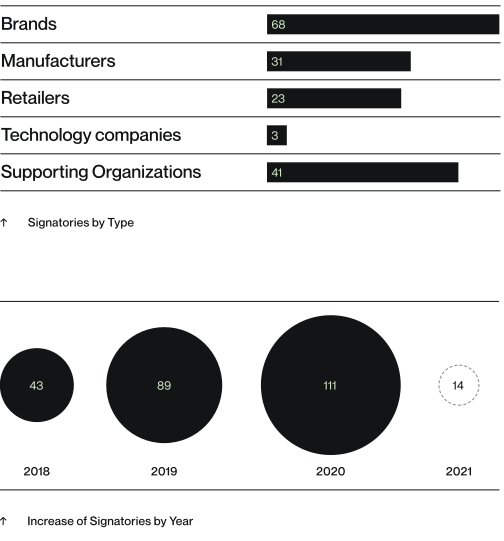
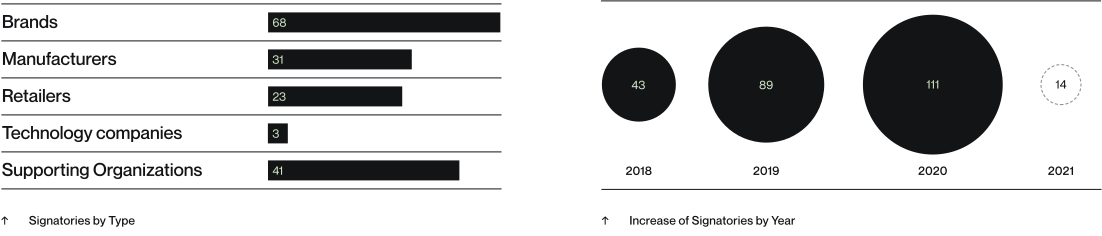
All Signatories
Supporting organizations
Supporting organizations
- Textile Exchange
- 2050
- Business for Social Responsibilities (BSR)
- Sustainable Fashion Academy (SFA)
- Global Fashion Agenda (GFA)
- GCNYC Fair Fashion Center
- Global Organic Textile Standard (GOTS)
- Sustainable Apparel Coalition (SAC)
- Outdoor Industry Association (OIA)
- World Wildlife Fund
- ZDHC Foundation (Zero Discharge Of Hazardous Chemicals Foundation)
- China National Textile and Apparel Council (CNTAC)
- Smart Freight Centre
- China Textile Information Center (CTIC)
- Earthworm Foundation
- Partnership For Sustainable Textiles
- International Textile Manufacturers Federation (ITMF)
- COFREET
- International Chamber of Commerce (ICC)
- Fashion for Good
- Apparel Impact Institute
- HSBC Holdings plc
- Solidaridad
- Fashion Revolution
- Better Cotton Initiatives
- Bangladesh'Garment Manufacturers & Exporters Association (BGMEA)
- Australian Fashion Council
- Amfori
- Condé Nast International
- International Finance Corporation (IFC)
- Bluesign
- Sustainable Fashion Business Consortium
- British Fashion Council
- Futerra
- Centre for Sustainable Fashion
- TEXFOR (Spanish Textile Industrial Association)
- Canopy
- OEKO-TEX® Association
- TreeToTextile
- AITEX Textile Research Institute
- rén collective
Charter work in 2019 and 2020
Since 2019, signatories have moved from a building a common understanding of workplans and potential deliverables to beginning the development of a long-term decarbonization pathway for the industry.
Charter work in 2019 and 2020
Since 2019, the signatories have moved from building a common understanding of workplans and potential deliverables to beginning the development of a long-term decarbonization pathway for the industry.
The work under the Charter in the first part of 2019 was dedicated to developing a common understanding of workplans, potential concrete actions, expected deliverables in the near term and how to implement the long-term vision. A fast-track plan for the year was agreed upon to signal urgency and expedite action. The working groups engaged in mapping existing guidelines, tools, organizations and programmes to understand the landscape and consequently identify a more focused approach going forward. A number of surveys were carried out to find out commonalities in both challenges and opportunities with regard to climate action across signatories that could inform the Charter approach. Additionally, working groups with cross-cutting interests were identified to align workplans and maximize results.
Among Charter signatories, there is a strong consensus to focus on real, tangible actions, while working in parallel to address the longer-term strategy for sector decarbonization. Signatories also agreed to prioritize a number of countries across working groups and ensure that work under the Charter promotes the use of existing programmes and tools as much as possible. More specifically, it was decided that there should be measurable targets around energy efficiency and renewable energy across signatory brands, retailers and manufacturers. At the same time, it was decided that the Charter would explore renewable energy solutions and programmes for suppliers, ensuring a broad reach and cooperation across the supply chain.
Despite the COVID-19 pandemic, the Charter working groups continued regular meetings and work throughout 2020, and the annual meeting took place virtually on 14 and 15 October 2020, bringing together more than 150 participants. Signatories reflected on the level of ambition, mid-term areas of focus for the working groups and a pathway for a rapid action plan.
The high-level segment of the meeting, moderated by Lucy Shea, Chief Executive Officer of Futerra, saw the participation of the UNFCCC Executive Secretary, Patricia Espinosa, the COP High-Level Climate Champion, Gonzalo Muñoz, the President of the Bangladesh Garment Manufacturers and Exporters Association, Rubana Huq, the Chief Executive Officer of Puma, Bjørn Gulden, the Chief Sustainability Officer of Nike, Noel Kinder, and the Chief Technology Officer of Tal Apparel, Delman Lee, for a panel discussion on the urgency of climate action during the COVID-19 pandemic.
On 10 December 2020, the Charter hosted a climate dialogue for the fashion industry as part of the Race to Zero Dialogues, convened by the High-Level Champions for Global Climate Action. These dialogues were designed to be a milestone on the road to COP 26, as a way to engage with key industries to capture progress on climate action so far and to develop a clear decarbonization pathway with commitments for each sector that can be brought into the COP dialogues alongside government-driven NDCs. The Charter's dialogue centered on important deliverables for fashion sector decarbonization and the importance of policy, finance and engaging the Global South (summary available here).
References
15 Scope 1: all direct GHG emissions from sources owned and controlled by a company; Scope 2: indirect GHG emissions from the generation of electricity, heat and steam purchased by a company; and Scope 3: other indirect emissions (outside the direct control of the entity, such as from a company's value chain activities).
16 According to the definition by the Sustainable Apparel Coalition, where Tier one corresponds to final product manufacturing and assembly (or finished goods production), and Tier two to material manufacturing (or finished materials production).